When the Board of the Green Climate Fund meets in Bali, Indonesia from February 19-21, the GCF’s mandated “gender-sensitive approach” is finally full-fledged on the agenda – and no longer treated under “any other business”. This policy analysis by Elizabeth Eggert (UNDP) and Liane Schalatek looks at options to integrate gender considerations into the operational modalities up for discussion and decision in Bali.
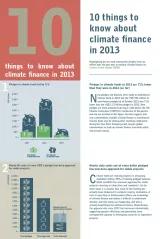
A series of graphs highlights the ten most noteworthy insights from monitoring dedicated public climate finance flows on the joint Böll-ODI website project Climate Funds Update (CFU).
In time for COP 19 in Warsaw (Poland), this series of 11 short introductory briefings, written in co-operation with the Overseas Development Institute, has been updated to reflect the latest data available on www.climatefundsupdate.org, the tracking project of ODI/hbf of dedicated climate financing instruments from pledge to project.
By “upping the ante”, the Board of the Green Climate Fund (GCF) at its recent 5th meeting in Paris accelerated its decision-making under the Fund’s Business Model Framework and set a time-line for the initial resource mobilization process of the Fund.
As the Board of the Green Climate Fund meets in Paris from October 7-10 with a long agenda and the urgency to move ahead with far-reaching decisions, it is crucial that the mandate of the Governing Instrument's for the GCF to follow "a gender-sensitive approach" is considered in the context of the policies waiting for for the Board's approval. See a joint policy brief by the Heinrich Böll Foundation North America and the climate finance working group of the Global Gender and Climate Alliance.
At COP18 in Doha, a decision was made urging Parties to promote gender balance in bodies established under the international climate regime. This HBF submission details actions to make UNFCCC climate finance bodies not only gender-balanced, but more gender-responsive…
At its recent meeting in Songdo, South Korea, the GCF Board was faced with a number of ambitious decisions on the Business Model Framework for the Fund, with disagreements about the involvement of the private sector, access of countries to the Fund and what financial instruments to employ. Board members were able to agree on Heda Cheikhrouhou from the African Development Bank as the new Executive Director for the Fund's Secretariat.
When the Board of the Green Climate Fund (GCF) convenes for its fourth meeting from June 25-28, 2013 in Songdo, South Korea, the discourse on the Business Model Framework (BMF) for the Fund will dominate the meeting agenda. Also on the agenda is the selection of the new Executive Director for its Independent Secretariat.
The post-2015 development agenda and the Sustainable Development Goals (SDGs) have the potential to make a positive, long-lasting difference in addressing today's myriad of unresolved challenges and fundamental crises if they focus on gender equality and macro-economic policy reform. This paper analyses how gender equality is taken up in the post-Rio+20 process.
At their third meeting from March 12 - 15 in Berlin, the Board of the Green Climate Fund laid the groundwork for some of the most important decisions it will have to make for the Fund's future in the remaining two Board meetings this year so that the Fund can propel the paradigm shift to low-emission, climate-resilient and gender-responsive sustainable development in recipient countries.