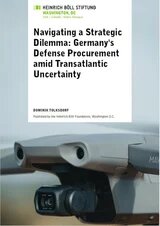
As the relationship with the U.S. government is fundamentally shifting, Germany faces a critical choice between deepening transatlantic defense procurement or seizing the moment to build out Europe's defense-tech ecosystem.
This publication analyzes the policies of the United States, and the European Union, and Turkey in the region and their impact on the relationship between Ankara, Washington, and Brussels.
This E-Paper analyses the results of the European Election in Germany and the specific impacts on national politics and the competition between the parties in Germany.
Over five million Iranians are in exile – about 120,000 of which live in Germany. They are influencing political and cultural debates in Iran on a daily basis. The aim of this publication is to promote a process of reflection within the diaspora and provide an input concerning the role and potential of the diaspora community in the US and Germany as well.
Armed unmanned aerial vehicles (UAVs) — more commonly referred to as drones — have become a central pillar of the United States’ counterterrorism strategy. A number of European actors have expressed growing concern regarding the lack of transparency, accountability, and clarity surrounding the U.S. drone program. Read the joint conference report by hbs and the Stimson Center on this pressing issue here.
In this report, we assess the potential of three relatively promising international processes – the focus on fossil fuel subsidy (FFS) reform in the G20 group, the Sustainable Development Goals (SDGs), and the Transatlantic Trade and Investment Partnership (TTIP) – to act as possible routes to reform in a transatlantic context.
Most important now is that the international community responds speedily and clearly to what amounts to a Russian occupation of the Crimea and the additional threat of Russian troops being stationed in Ukraine. Europe is in no way powerless in the face of Russian actions, as Ralf Fücks and Walter Kaufmann illustrate in a ten-point plan.
The Transatlantic Trade and Investment Partnership (TTIP) could include rules on investment protection, including so called investor- state dispute settlement (ISDS).
TTIP will affect a broad range of issues, from energy to the environment, and intellectual property rights to labor rights. The agreement could also have a significant impact on the evolution of agricultural markets and food systems in the U.S. and EU.
Germany is in the midst of a unique campaign season, gearing up for the September 22 elections. Despite this wide gap between the two frontrunners, Angela Merkel of the Christian Democratic Union (CDU) and current chancellor and Peer Steinbrück of the Social Democratic Party (SPD), the final results are far from certain. Mattis Hennings reviews main campaign issues and the politics behind the elections.