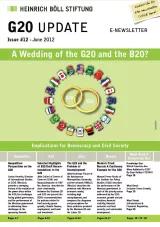
How should G20 Decisions be Assessed? This question is answered by a December 2012 report entitled, “Mapping G20 Decisions Implementation: How G20 is delivering on the decisions made” by scholars at the University of Toronto and the Higher School of Economics (Moscow). This "commentary" questions the methodology of the report and suggests alternatives.
After introducing the topic of corruption, this paper identifies the G20 anti-corruption commitments and progress (or lack thereof) in the implementation of these commitments. It also proposes goals for the Working Group in 2013 and beyond.
This paper provides an introduction to the G20 in the lead up to Australia’s G20 presidency. It includes an overview of the G20’s work in the last five years and the likely agendas for 2013 and 2014; and describes aspects of the global and Australian context.
This article assesses the G20's performance against its seven commitments to reform the financial sector. The Financial Stability Board (FSB) has significant responsibility for carrying out the mandates of the G20 in this sector.
On December 1, 2012, the G20 welcomed its new leadership “troika”– Russia, Mexico, and Australia – the current, past and future presidents, respectively. The Russian G20 Presidency has announced its priorities for the 2013 Summit.G20 Sherpas, or presidential aides, will meet in Moscow in mid-December. At the same time, civil society, think tanks, and business leaders will gather to hammer out recommendations to present to the Sherpas.
Many powerful transnational corporations (TNCs) have growing influence over the governance of resources in sectors, such as energy and agriculture. This paper addresses the strategic dilemmas faced by civil society organizations that address corporate power in their struggles to curb global warming and achieve the human rights, including the rights to food and energy.
In, “The pros and cons of public-private partnerships (PPPs) as a means to achieve food security, expanded infrastructure investment and green growth?" Nancy Alexander provides a background paper on PPPs (part I) and conclusions of a discussion of the paper with the Mexican Foreign Service (part II).
Since the Mexican G20 Summit, the Eurozone crisis and the U.S. slowdown are hitting many emerging and developing countries suffer from declines in industrial output, export growth, trade and inflows of capital.
This month, two events occur back-to-back: the United Nations Conference on Sustainable Development (“Rio +20”) in Brazil and the Group of 20 (G20) Summit, in Mexico. This paper asks how the powerful G20 might influence outcomes of Rio+20.
The eurozone crisis hijacked the French G20 Summit and shows every sign of doing the same at the Mexican Summit, as fear of a Greek exit (“Grexit”) from the eurozone morphs into panic over Spain (“Spanic”).