Shaping the future of multilateralism: An overview on inclusive pathways to a just and crisis-resilient global order Published: 25 August 2021 Summary paper The 20 authors of the 15 papers in this series illuminate the depth of the problems in the three specific fields of international trade, digital governance, and climate finance, with special attention to human rights and gender equality. The researchers illustrate the profound failures of national governments and international mechanisms, and often reflect the frustrations of populations or countries that feel the rich and powerful are running roughshod over the poor, marginalized, and vulnerable for their own outsized benefit, and are doing so with impunity. Viola Gienger, Sabine Muscat, Liane Schalatek, Anna Schwarz, Lisa Tostado
Does data protection safeguard against gender-based risks in Southern Africa? Published: 8 July 2021 Study The increasing data-driven nature of societies raises concerns about how to prevent data misuse and abuse that may harm individuals and communities, particularly marginalized groups. A feminist critique of the model law on data protection of the Southern African Development Community and the EU’s GDPR, however highlights the dangerous gaps that place women and gender-diverse people at risk. Chenai Chair
Just and sustainable finance to address multiple global crises demands a focus on gender equality Published: 1 July 2021 Study In this time of triple crises, with intersecting impacts from the pandemic, the climate emergency, and persistent economic inequality, the global community and its leaders face a “Kairos moment” – a turning point at a critical time for action. The choice is whether to continue with failed policies that have brought the world to this perilous juncture or to retool global economies and systems. Imaginative and transformative approaches could address climate change and other environmental, health, and social threats, based on equity and justice, including gender-equitable access to sustainable finance. Mariama Williams
Barbara Unmüßig: "No country is safe until all countries are safe from Covid-19" Published: 28 June 2021 Keynote speech Given the global dimension of the Covid-19 pandemic and the fact that the number of mutations is increasing worldwide, we must overcome our selfish national and economic interests. Successful pandemic response requires coordinated global action based on coordinated decision-making, fair and transparent vaccine delivery processes and know-how sharing. Barbara Unmüßig
Imbalanced foreign trade, debt, and investment in developing countries: The case of Georgia Published: 22 June 2021 Study Georgia remains a developing country even three decades after its independence from the Soviet Union and despite its strategic location and abundant natural resources. It has benefited to a limited extent from foreign investment and relatively recent free-trade agreements with the EU and China. But its full emergence as an economically and politically resilient State has been hampered by a modernization-driven development agenda and neoliberal policies, with too little regard for their social and environmental impacts in Georgia. The country also has been held back by high-pressure, counter-productive trade- and lending policies imposed by global powers such as the IMF, the EU, the United States, and China. Ia Eradze
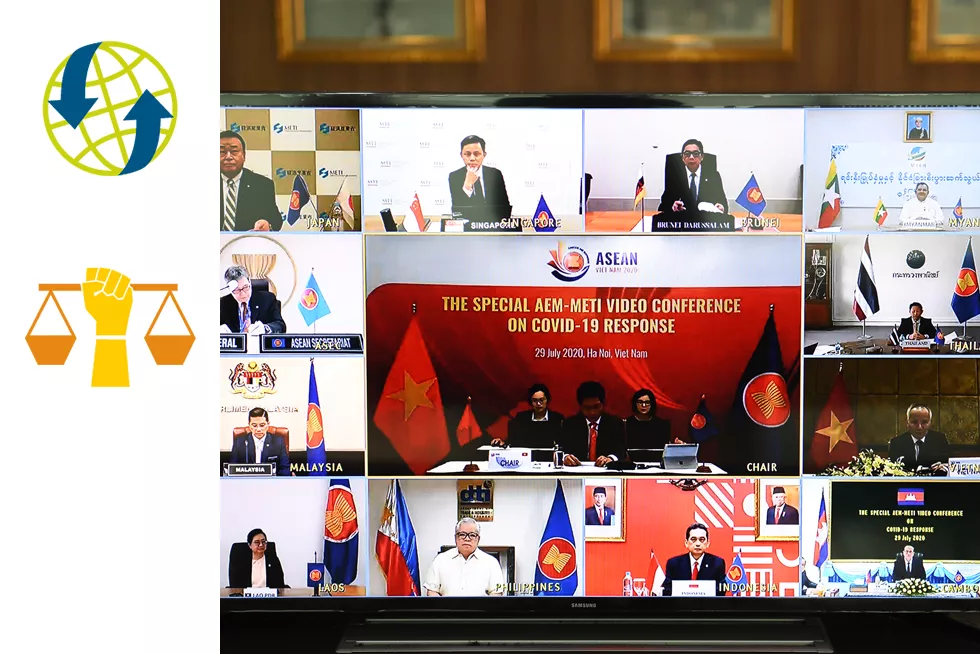
How multilateralism does and doesn't work in ASEAN Published: 17 June 2021 Study Populism, nationalism, and an intensifying rivalry between the United States and China are testing the cooperation within the Association of Southeast Asian Nations (ASEAN). As its 10 member States battle the effects of Covid-19 amid political and territorial crises, the group has struggled to overcome internal differences and address profound external challenges. Deasy Simandjuntak
Could South Africa, spurred by Covid-19, drive more equitable global trade norms? Published: 17 June 2021 Study Major multilateral institutions have long claimed that their market-oriented trade rules reduce poverty and advance development. Instead, they hold back the developing world from a more human-centric, social-justice approach that it needs to reach its potential. South Africa has the potential to set an example of how a global “middle power” can drive change. The Covid-19 pandemic has provided extra impetus – and a test. Arina Muresan, Sanusha Naidu
India as archetype: What emerging data powerhouses need for effective information sharing Published: 16 June 2021 Study The need for cross-border data sharing throughout the Covid-19 pandemic has shown that the future of multilateral threat management will hinge on steady yet flexible open-data publishing norms and multilateral data-transfer agreements. In many ways, India typifies the perspectives and needs of emerging economies related to data sharing, data flows, and related commercial regulation. Kim Arora
Persistent turbulence in Turkey and the EU calls for restored cooperation for a post-pandemic world Published: 16 June 2021 Study Turkey and multilateral institutions alike, including the European Union, were already struggling with political and economic crises in the years before the pandemic multiplied the sense of catastrophe. As they seek to pull themselves out of the depths of Covid-19, it is time to set aside the divisions that have long stalled progress for all of them, and seek recovery in cooperation and mutual benefit. Evren Dinçer
Towards a “digital new deal” for Latin America: Regional unity for a stronger recovery Published: 16 June 2021 Study The absence of an integrated digital market and a unified political vision for tech policy in Latin America and the Caribbean puts the countries of the region at risk of dependency on a foreign private sector for their digital transformation. The investment that will be required to recover from the pandemic offers a unique chance to break out of the current market logic and treat technology as critical social infrastructure that must be sustainable and requires citizen participation. Renata Avila
Access to the Covid-19 vaccine in Venezuela Published: 14 June 2021 Study The outbreak of the pandemic could have spelled disaster for Venezuela, already two decades into a political, social, economic and health crisis. The combination of a collapsed national health system and economy, a complex humanitarian emergency, a continuous stream of migration, an internal political conflict with international ramifications, a population with high levels of malnutrition, has seriously hindered the development of a successful vaccination programme. Thus far, Venezuela has administered the fewest number of Covid-19 vaccinations in relation to its population size of all the countries in South America. Henry Jiménez Guanipa
Covid-19 Vaccine Distribution in South Africa Published: 14 June 2021 Study Health inequality increased sixfold in South Africa under COVID-19, suggesting that the crisis affected the health of the poor far more than the relatively well-off. Race is not a significant predictor of vaccine hesitancy, but trusting social media as an information source is positively correlated with vaccine hesitancy. South Africa has pushed hard against opposition to the proposal for a waiver of IP for Covid-19 technologies at the World Trade Organisation (WTO). Lauren Paremoer, Leslie London
Access to the Covid-19 vaccine in Israel Published: 14 June 2021 Study The rate of COVID-19 vaccination in Israel is one of the highest in the world. However, vaccine rates are not evenly distributed among the different population groups. Arab citizens and the Ultra-Orthodox population, who have suffered the most from the pandemic, are vaccinated at lower rates than the general public. Moreover, social media disinformation campaigns that have characterized the COVID-19 pandemic in Israel, in general, and the vaccine, in particular, has been one of the causes of vaccine hesitancy. Dr. Shelly Kamin-Friedman
Covid-19 vaccine access in the South Caucasus Published: 14 June 2021 Study After the first cases of COVID-19 were detected in Armenia, Azerbaijan, and Georgia last spring, the three countries embarked on very different courses of action to tackle the virus. While Georgia moved to quickly close its borders and initiated a strict lockdown, Armenia and Azerbaijan were slower to respond, though both eventually instituted lockdowns of their own. Over the last year, other events in the region have overshadowed the pandemic to some extent. Ani Avetisyan, Hamida Giyasbayli, Shota Kincha
Dealing with scarcity: equitable access to Covid-19 vaccines in Colombia Published: 14 June 2021 Study The global Covid-19 pandemic has hit Colombia strongly. This article presents an overview of the vaccination programme in Colombia and some recommendations for international actors to speed up the process and guarantee equitable access to vaccines. Diana Guarnizo Peralta, Johnattan García Ruiz, Diana León
Dealing with scarcity: equitable access to Covid-19 vaccines in Colombia Published: 14 June 2021 Study The global Covid-19 pandemic has hit Colombia strongly. This article presents an overview of the vaccination programme in Colombia and some recommendations for international actors to speed up the process and guarantee equitable access to vaccines. Diana Guarnizo Peralta, Johnattan García Ruiz, Diana León
Covid-19 vaccination in Chile Published: 14 June 2021 Study The Covid-19 pandemic has become Chile’s most consequential public health challenge in a century. Chile’s measures included guidance regarding, among other items, education, health (sick leaves, diagnoses, hospital capacity, partial and spatially targeted lockdowns), mass events, border controls, supply and transportation. Since then, the evolution of the disease in the country has been similar to that of other countries around the world, with periods when cases increased followed by periods when cases declined, yet without ever declining to a point when one would assume the emergency was over. Juan Jorge Faundes Peñafiel, Andrea Lucas Garín, Gloria Lillo Ortega
Biometrics in Belgrade: Serbia’s path shows broader dangers of surveillance state Published: 19 May 2021 Study On the EU’s periphery, Serbia has deployed enough biometric surveillance technology from China’s Huawei for law enforcement and “Safe City” solutions to cover practically all of Belgrade’s public spaces. Public pressure has raised the bar for turning on the technology, but the alarming project illustrates the need for transparent regulation of such systems everywhere, to ensure the protection of fundamental human rights. Danilo Krivokapić, Mila Bajić, Bojan Perkov
Outlawing gender-based political violence: Can Tunisia’s example carve a multilateral path for others? Published: 19 May 2021 Study Expanding on the United Nations Women’s Rights Convention, Tunisia became the first Arab country to incorporate into its laws the notion of gender-based political violence. Can this concept now be incorporated into international instruments to benefit more women across the globe, starting with UN Women’s 2021 Generation Equality Forum? Besma Soudani Belhaj, Najla Abbes
Feminist, decolonial economic solutions to address interconnected global crises Published: 19 May 2021 Study The undeniable connections among the multiple crises that humanity faces today -- climate change, biodiversity loss, inequality, poverty, and the Covid-19 pandemic -- demand interconnected, rather than segmented, macro solutions. Responses must be systemic and address the structural dynamics and shortcomings of governance, economics and finance. A feminist and decolonial framing provides a lens for proposed reforms. Emilia Reyes